Showing posts with label Art. Show all posts

Thursday, October 9, 2014

Le Corbusier's Architecture and Urban Planning

Swiss-French architect Le Corbusier, one of the most influential modernist architects, got his life's biggest opportunity in realizing his vision of urban planning and design when the first Prime Minister of India, Jawaharlal Nehru, invited him to build a city from scratch. This city was to be the capital of the Indian part of Punjab that was created as a result of the 1947 partition of India and Pakistan. The city came to be known as Chandigarh, the first planned city of independent India.

Many of the city's buildings are regarded as Le Corbusier's finest works that demonstrate his principles of light, space, and greenery. His architectural designs also incorporated many Indian motifs that inspired him, such as bulls, cooling chimneys, arches of Mughal architecture, etc. In particular, he designed the buildings to be used by the three branches of the  new democratically elected state Government - The State Assembly (legislative), The Secretariat (executive), and the State High Court (judiciary), along with a monument, The Open Hand - a symbol of Peace and Reconciliation, and of giving and receiving ideas freely. It today stands in Chandigarh as a reminder of the opportunity that India gave him and the beautiful buildings that he gave to India. Undoubtedly, this entire project was very close to his heart; a few weeks before his death in 1965, Le Corbusier wrote in a letter:
"This symbol of the Open Hand, open to receive the wealth created, to distribute to the peoples of the world, must be the symbol of our age. Before I find myself one day (a little later on) in the celestial spheres amid the stars of God Almighty. I shall be happy to see at Chandigarh, in front of the Himalayas, which rise up straight upon the horizon, this Open Hand, which marks for père Corbu a deed, a certain distance covered, from you, André Malraux, from you, my associates, from you, my friends. I ask help in realizing this symbol of the Open Hand in the skies of Chandigarh, a city desired by Nehru, Gandhi's disciple."
                                                         PM Nehru and Le Corbusier

State Legislative Assembly (1955)


The Secretariat (1953)


The High Court (1956)


Open Hand Monument (sketch, 1953)

For additional details read: 

Sunday, July 20, 2014

The Photography of Andre Kertesz


What is the difference between a "good" photo and a "great" one? In my view it's in the composition. A careful and creative composition, which depends on deciding which elements to include in the photo and how to position them in the frame, elevates a photo from the craft of taking a snapshot to the level of pure art. One of the greatest "composers" of photography was Andre Kertesz whose photos revealed the hidden geometry in everyday objects when taken from interesting angles and perspectives. Another aspect of his works focused on revealing the unconscious self-refelctive  moments that his human subjects would find themselves in amidst the daily humdrum of crowded cityspaces. Kertesz would often wait for a long time to let the perfect composition arise naturally. These photos are only a glimpse into this visionary's fascinating body of work.


Monday, June 16, 2014

David Hockney's Art

David Hockney has been hailed as the greatest British painter alive, and perhaps only a few would like to disagree. The reason I am writing about Hockney is in part because he is one of the few artists who have appreciated the role of technology in the advancement of art, and used the latest offerings of science to create truly modern works.  

Hockney was already a rising star in Britain when he chose to move to Los Angeles because (by his own admission) he liked both the weather and liberal environment of California. He rose to fame in the 1960s (along with artists like Andy Warhol and Roy Lichtenstein) when the Pop Art movement was at its peak. One of Hockney's most famous paintings from this time, "A Bigger Splash" (seen below), is a playful and masterly composition in which rectilinear shapes (horizontal lines of the house and the pool edge, and the vertical lines of the trees) are only interrupted by the the oblique lines of the chair and the diving board, harmoniously echoing the way in which a splash left by an unseen diver interrupts the quietness of the surrounding scenery. It is also worth noting how the splash is crucial in providing the 3D effect in an otherwise remarkably (and deliberately) flat painting. This playfulness is very characteristic of Hockney's art.

 A Bigger Splash

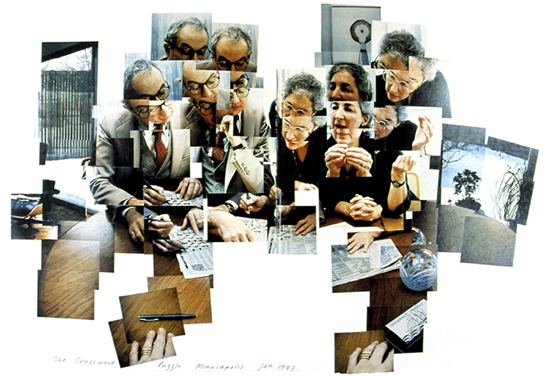
But Hockney is an inventor, for he keeps reinventing himself in different mediums. His deep admiration for photography has led him to adapt it as an integral technology used to create his compositions. However he has not fully satisfied with video recordings because he felt that any recording was limiting the viewer's ability to wander about in the composition by imposing a linear timeline on the sequence of photos that form the video. Instead he advocated "photo collage" or "joiners" as a better means of capturing and highlighting the aspects that the painter wants the viewer to notice. Seen here is an example of Hockney's photo collage of Minneapolis Walker Art Center's director and his wife solving crossword puzzles. It captures the entire process of thinking, wondering,  and the excitement of the "Aha!" moments as they solve the puzzles together. For more information about his "Joiners", watch  Hockney's interview on YouTube. 

Joiner: Martin Friedman and his wife solving a crossword puzzle

Hockney also explored this idea of capturing a sequence of events in his paintings after he came across Chinese scroll paintings, which depicted scenes temporally as opposed to a single snapshot or a single point of view. This led him to paint a series of pictures of the road that he took and the surrounding landscapes on his way to a hospital to meet a friend (see below). What Hockney was trying to capture in this series was the essence of the journey itself - the process rather than the end.    


An unrelenting innovator, an aged Hockney took up plein-air painting ("in the open") in 2006 when he returned to his native Yorkshire and created a series of fascinating landscapes in huge panels for the "A Bigger Picture" exhibition at the Guggenheim Museum in Bilbao. Hockney went back to using the photography and the latest digital technologies to align and superimpose the canvas paintings to create the large panels (seen below).

  Plein-air painting


A Bigger Picture

But what is most impressive about this extraordinary man is that he has moved onto a new medium -one which only the techno-buffs will become the early adopters of, or so you would think. This new medium is the iPad. Hockney, the innovator, is now creating his paintings on the iPad, and he recently had a successful exhibition in CA. Some of his paintings on the iPad can be seen below. You can also read more about Hockney's iPad paintings (wired.com). Hockney has opined that this technology which is poised to usher in a new wave of creativity is now in the hands of everyone, it's a new medium of self-expression -one that is accessible to all, even those without any formal academic training in art schools. Technology is once again advancing the arts and democratizing it for the masses to appreciate, much like the way the Renaissance painters brought art closer to masses. As Contemporary art continues to become ever more esoteric and idiosyncratic, trapped in the art galleries, cut off from the ordinary people, this is perhaps a very sobering voice of reason. 
  
 Hockney's iPad paintings

It is Hockney's fascination with not just painting, but the process as well, including the role of technologies in shaping art, that makes Hockney stand out. In 2000, Hockney and physicist Charles Falco proposed a controversial theory (and some evidence) that art historians had not fully grasped till then. Hockney argued that Renaissance masters like Jan van Eyck, Lorenzo Lotto, and Vermeer were using  concave mirrors to make their paintings realistic. In essence even before the advent of modern day photography and lenses, Renaissance painters had begun to use the basic principles of optics to make photorealistic paintings. Hockney argued that Arab scholar Ibn Al-Hytham's "Book of Optics" was the source for the Renaissance painters discovery of the technology, which resulted in a sudden improvement in their ability to paint realistic portraits and images in early 1400s. His theory has opened a new discussion on the history of science and what role it played in the advancement of Renaissance aesthetics. To learn more about this theory, watch Charlie Rose's interview of David Hockney about Camera Obsura.


It is Hockney's ability to bridge the worlds of science and arts that makes him an important figure in today's world. One without the other would be a much poorer world to live in. Hockney understands that and explore this interdependency to inform us of the past and open our eyes to imagine future possibilities.